REVIEW · WARSAW
Warsaw at War 1939-1945: A Self-guided Audio Tour
Book on Viator →Operated by VoiceMap Audio Tours · Bookable on Viator
Warsaw’s WWII footsteps are easy to follow. This self-guided audio walk from the Old Town area turns major 20th-century moments into step-by-step listening, ending at Józef Piłsudski’s monument. I love the offline access to audio, maps, and geodata, and I also like how the narration is engineered with sound effects and music so it feels vivid without needing a live guide.
One thing to keep in mind: the navigation guidance and the alert when you leave the route can be a bit too sensitive, so you may want to slow down and re-check the map if you get off by a few steps. Still, the format is flexible, and you can pause anytime to wander toward places like the Saxon Garden or grab a meal along the way.
In This Review
- Key Highlights You’ll Actually Use
- Why a Self-Guided War Walk Fits Warsaw So Well
- Start at Kościół Akademicki św. Anny and Get Your Bearings
- The Old Town Route: How the Story Gets You Moving
- Mały Powstaniec Stop: Child Soldiers and the 1944 Warsaw Uprising
- Tomb of the Unknown Soldier: Respect, Then Context
- Ending at Piłsudski: A Heroic Arc (with Independence as the Theme)
- Audio, Offline Maps, and the Small-Group Feel
- Price and Value: What $9.99 Buys You
- Navigation Alert Sensitivity: How to Avoid the Common Friction
- Who Should Book This Audio Tour (and Who Might Skip It)
- Should You Book Warsaw at War 1939–1945?
- FAQ
- How long is the Warsaw at War 1939-1945 audio tour?
- What’s the walking distance?
- Is the tour available in English?
- Do I need internet during the tour?
- Are museum tickets included?
- Where does the tour start and end?
- Can I pause to explore on my own?
Key Highlights You’ll Actually Use

- Offline audio, maps, and geodata mean you can keep walking even if your signal drops.
- 90 minutes and about 3 km is a very doable amount of walking for a history-focused route.
- Mały Powstaniec memorial brings the Warsaw Uprising of 1944 into focus through the story of child soldiers.
- Tomb of the Unknown Soldier includes the memorial’s special detail: ashes and soil from every 20th-century battlefield where Polish soldiers died.
- End point at Piłsudski’s statue ties the WW2 period to the broader independence story the tour emphasizes.
- Small experience size (max 10 travelers) keeps things from feeling crowded, even though it’s self-guided.
Why a Self-Guided War Walk Fits Warsaw So Well

Warsaw can feel big and busy, but this kind of route is designed for your pace. You’re not stuck in a rigid line. You follow the audio direction, pause when you want, and spend your attention on the streets and the stories tied to them.
This also helps with one of the hardest parts of war-related history: learning it without rushing. The tour gives you a walking framework across key places, but you can slow down, stop to look, and take it in without anyone herding you onward.
If you like planning trips with intention, this one is great because it’s only about 90 minutes. You can fit it between meals, build it into a day that also includes other Old Town sights, or use it as a strong first introduction before you explore deeper on your own.
Other guided tours in Warsaw



Start at Kościół Akademicki św. Anny and Get Your Bearings
You begin at Kościół Akademicki św. Anny, on Krakowskie Przedmieście 68. From there, the audio leads you away from the starting area in an exploratory walk that ends at the Statue of Józef Piłsudski in Plac Marszałka Józefa Piłsudskiego.
Here’s the practical part that matters: the tour asks you to start in the app and then effectively put your phone away. That’s a nice shift from screen-watching to actually walking. It can also reduce the temptation to constantly check your map and get mentally stuck on your device instead of what’s in front of you.
With about 3 km total walking distance, you should plan for a steady stroll rather than power-walking. The scheduled time is about 90 minutes, but the real time depends on how often you pause to read plaques, take photos, or detour toward nearby options (the Saxon Garden and lunch spots are mentioned as good possibilities along the way).
The Old Town Route: How the Story Gets You Moving
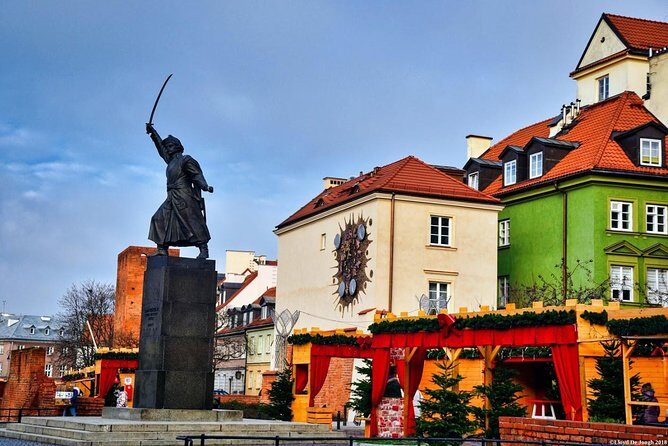
The tour begins just outside the famed Warsaw Old Town and builds its narrative while you’re walking. That matters because you’re not consuming history in one single indoor block. Instead, the places you stop at start to make emotional sense as the audio connects them.
A key strength is the production quality. The narration is crisply mastered by professional audio engineering, and it’s designed to be engaging for different listeners. You’ll hear sound effects and music used to shape the mood. It’s not just factual talking; it’s an audio experience that helps you “stay present” even when you’re thinking about heavy subjects.
You also get a useful flexibility advantage. You can pause anytime and explore further wherever you are. That means if you notice something that pulls your attention—an open square, a viewpoint, or a nearby museum—you can take a quick detour and then hop back into the audio when you’re ready.
One more detail that’s worth planning around: the tour format is suitable for all ages, and it can work with earbuds, headphones, or even a small group speaker. So if you’re traveling with someone who prefers sharing audio instead of everyone wearing headphones, this route won’t force your whole group into one listening style.
Mały Powstaniec Stop: Child Soldiers and the 1944 Warsaw Uprising
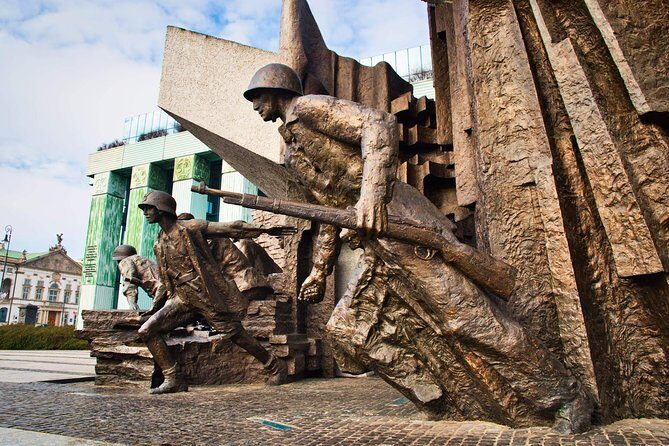
At some point on the route, you’ll learn about Mały Powstaniec, often translated as the Little Insurgent. This is a memorial connected to child soldiers who fought and died during the Warsaw Uprising of 1944.
This stop is powerful because it doesn’t let the story stay abstract. Even if you already know Warsaw had an uprising, the memorial focuses your attention on what that war meant at a human scale—especially the harsh reality that children were caught up in fighting.
A good way to get the most out of this moment is to slow down when you hear that section coming. Don’t treat it like a quick photo-op stop. Let the narration finish the thought, then look around the memorial area like you’re reading it with your eyes too. When you pair “what you hear” with “what you see,” it tends to land harder—in a good way.
If you’re with kids or teens, this is also where the audio style helps. Since the tour is designed to be suitable for all ages, the delivery is built to be listenable while still carrying weight. Just keep in mind the subject matter is serious.
Tomb of the Unknown Soldier: Respect, Then Context
Another major stop includes a pause at the Tomb of the Unknown Soldier. The tour frames it as a moment to pay respects to those lost fighting for their country. Then it adds the specific story detail that makes this monument stand apart.
You’ll learn about the monument’s history and, importantly, how it contains ashes and soil from every 20th-century battlefield where Polish soldiers lost their lives. That one sentence detail changes how you look at the place. It turns the tomb from a single memorial site into a kind of collection point for many wars and many losses—across an entire century.
In practice, this is where you might want to stand still for a minute after the audio ends. Take the time to absorb the atmosphere rather than rushing off just because the walking route continues. War history can hit in waves, and monuments like this deserve a pause button.
A few more Warsaw tours and experiences worth a look

Ending at Piłsudski: A Heroic Arc (with Independence as the Theme)
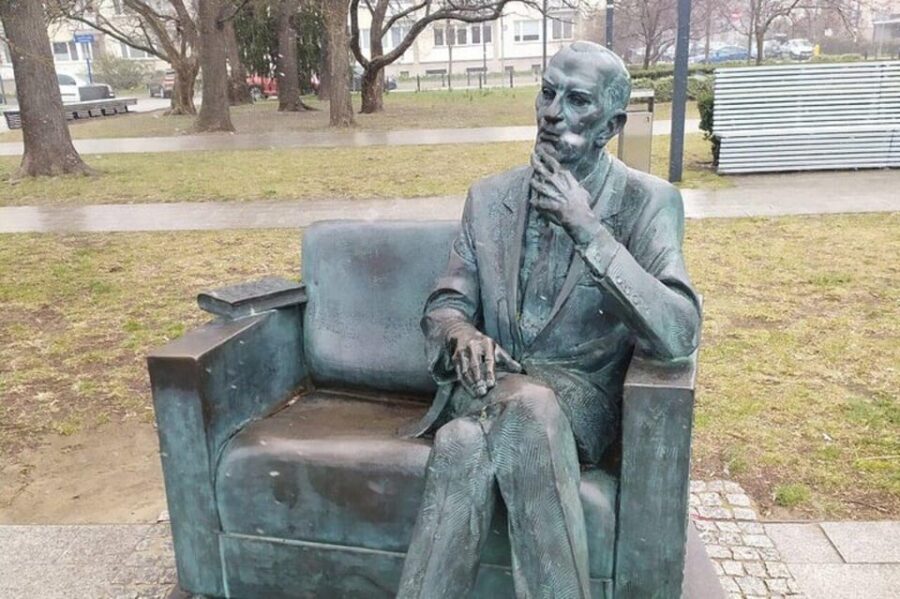
The tour ends with a face-to-face meeting with Marshall Józef Piłsudski, and your final destination is the statue at Plac Marszałka Józefa Piłsudskiego. The audio connects this figure to the wider struggle for Polish freedom.
You’ll hear how the tour presents Piłsudski as a political and military hero who fought to free Poland from Russian control, and it also includes the claim that he ultimately defeated Lenin’s red Army at the gates of Warsaw in 1920.
This ending works well after the WWII-focused content because it broadens the story. Instead of treating WWII as a standalone tragedy, the tour frames Warsaw’s suffering and survival as part of a longer independence struggle. Whether you already know Piłsudski or you’re learning him for the first time, you’ll leave with a clearer sense of why symbols and monuments matter so much in Warsaw.
Also, since the whole walk is only about 90 minutes, it’s smart to save some energy for the last stop. Don’t schedule a long, demanding detour right before the Piłsudski section. Finish the audio calmly, then continue exploring Old Town or the surrounding areas once you’re done.
Audio, Offline Maps, and the Small-Group Feel
This is powered by the VoiceMap application. You get lifetime access to the tour, which I think is a real advantage if you travel more than once or if you want to revisit the route later when your knowledge deepens.
The offline features are the practical win: you’re able to access audio, maps, and geodata without relying on mobile data. That reduces stress. It also means you can focus on the route rather than hunting for signal.
The audio format is built to be flexible for your listening hardware. You can use ear buds or headphones. And if you’re with a small group, the option to use a small speaker can be useful for shared discussion.
And even though it’s self-guided, there’s a stated maximum of 10 travelers for this experience. That matters because it usually means fewer people trying to start at the same time and fewer crowds at the edges of major stops.
Price and Value: What $9.99 Buys You
At $9.99 per person for about 1 hour 30 minutes, this is priced like a low-cost “tour upgrade” rather than a big-ticket guided service. The value comes from what you get alongside the audio.
You receive:
- Lifetime access to the Warsaw at War 1939-1945 tour
- The VoiceMap app experience
- Offline access to audio, maps, and geodata
So you’re paying not only for one walk, but for a reusable resource. That’s especially valuable if you plan to revisit Warsaw or if you want to share the route mentally later when you compare it with other WWII stops.
What’s not included is also clear: you won’t get transportation, food, or museum entrance tickets along the way. If you plan to visit specific attractions—like the Vodka Museum mentioned as a possible detour—you should budget separately.
If you’re already comfortable walking on your own, this becomes a smart way to add emotional and historical structure to a day. If you strongly prefer live narration and Q&A, you might miss that personal back-and-forth.
Navigation Alert Sensitivity: How to Avoid the Common Friction
One drawback worth flagging comes down to route guidance. In one case, it was difficult to follow navigation because the map guidance wasn’t obvious enough, and the alert that you left the route could trigger too easily (even when someone walked on the other side of the street).
So here’s how I’d handle it if you want this to stay stress-free:
- Treat the route as approximate at street level and expect to make minor adjustments.
- If an alert sounds, pause your walking for a moment, check where you are on the map, then re-align.
- Don’t let one beeping moment turn into a whole detour of frustration. Just reset and move with purpose.
In other words, don’t fight the app. Work with it. The tour still has the flexibility to pause, explore a bit, and then rejoin the audio logic.
Who Should Book This Audio Tour (and Who Might Skip It)
You’ll love this if you:
- Want a self-guided way to learn WWII-era Warsaw with a clear route structure.
- Like walking and listening, rather than sitting in one place.
- Travel solo or in a small group and want freedom to pause for photos, gardens, or lunch.
- Appreciate well-produced audio with sound effects and music, not just dry narration.
You might think twice if:
- You strongly dislike app-based navigation cues or want very obvious visual arrows.
- You’re the type who needs constant staff support to keep on track.
In a city with so many layers, an audio walk like this can be a smart “first pass.” It gives you anchors: Mały Powstaniec, the Tomb of the Unknown Soldier, and Piłsudski. Then you can build from there however you like.
Should You Book Warsaw at War 1939–1945?
Yes, I’d book it if you want a low-cost, high-impact way to understand Warsaw during 1939–1945 without being trapped in a schedule. The offline audio and maps are a huge quality-of-life feature, and the route length is short enough that you can pair it with other sightseeing the same day.
If you’re cautious about navigation alerts, plan for a calmer start. Give yourself a few extra minutes at the beginning to get oriented at Kościół Akademicki św. Anny. Once you’re walking confidently, the story does the rest.
FAQ
How long is the Warsaw at War 1939-1945 audio tour?
It’s about 1 hour 30 minutes (approximately).
What’s the walking distance?
The walk is approximately 3 km.
Is the tour available in English?
Yes, the tour is offered in English.
Do I need internet during the tour?
No. The tour includes offline access to audio, maps, and geodata.
Are museum tickets included?
No. Tickets or entrance fees to museums or other attractions are not included.
Where does the tour start and end?
It starts at Kościół Akademicki św. Anny, Krakowskie Przedmieście 68, 00-322 Warszawa and ends at the Statue of Józef Piłsudski, Plac Marszałka Józefa Piłsudskiego, 00-073 Warszawa.
Can I pause to explore on my own?
Yes. You can pause anytime and explore further wherever you are.
—
If you want, tell me what day you’ll be in Warsaw and what else you’re planning to see (Old Town, Łazienki, museums, food stops). I can suggest a simple half-day or full-day pairing around this walk.