REVIEW · WARSAW
Private 4h Tour in Warsaw Old Town
Book on Viator →Operated by PT Team · Bookable on Viator
Warsaw reads like a storybook with scars and repairs. This private 4-hour route connects the symbols you’ll see all over the city to the bigger events that shaped them, from royal power to WWII loss and rebuilding.
I especially like two things: first, the way the tour strings landmarks together so you understand how Warsaw’s layout and meanings fit the city’s history, not just the sights. Second, the human touch—guides like Maria and Cesar (names that come up in past groups) are praised for clear explanations and for pointing out visual proof like before-and-after war photos. Still, with 10+ stops in about four hours, it moves fairly efficiently, so if you want a slow museum-style day, you might feel a bit rushed.
In This Review
- Key things to know before you go
- Why this Warsaw Old Town route is built for real understanding
- Starting at Sigismund’s Column: the symbol and the shifting map
- UNESCO Old Town: seeing the trade route city, then the 1944 loss
- Royal Castle Gardens: where royal power and wartime retaliation meet
- St. John’s Archcathedral: old walls, national moments, and organ music
- Rynek Starego Miasta and the Warsaw Mermaid: a square with layers
- Barbican Warszawski: defenses you can walk, and an exhibition if the season fits
- Warsaw Uprising Monument and the quiet power of remembrance
- Ulica Miodowa: one narrow street, several stories at once
- Plac Teatralny and the Grand Theatre: civic culture, postwar rebuild, and façades
- Tomb of the Unknown Soldier: the noon guard moment
- Ending on the Royal Route: from Zamkowy Square to Trzech Krzyży Square
- Price and value: what $111.75 gets you in four hours
- Who should book this private Warsaw Old Town tour?
- Should you book this Warsaw Old Town private tour?
- FAQ
- Is this tour private or group-based?
- What language is the tour guide?
- How long is the Private 4h Tour in Warsaw Old Town?
- How much does the tour cost?
- Where do we meet and where does the tour end?
- Are there admission tickets required for the stops?
- Do I need a paper ticket?
- Can I cancel for free?
Key things to know before you go
- Private group pacing: Only your group goes with the guide, which makes it easier to ask questions and adjust your walking pace.
- Old Town + Royal Route in one sweep: You cover UNESCO Old Town highlights and then continue along the broader Royal Route area.
- Free entry at every listed stop: Each stop in the itinerary is marked admission ticket free, which helps the tour feel like real value.
- A WWII-to-today emphasis: Expect concrete context for what was destroyed and what was rebuilt, not vague generalities.
- English guide and mobile ticket: The tour runs in English and uses a mobile ticket, so you can travel light.
- Guide finishes early, you keep exploring: The guide leaves you near Krakowskie Przedmieście, so you can continue at your own pace.
Why this Warsaw Old Town route is built for real understanding
Warsaw’s center can feel like one big “look-and-guess” if you only wander on your own. This tour is different because it’s arranged like a guided map of meaning. You start at a major city symbol, then work through the UNESCO Old Town area, and you finish on the Royal Route, where a lot of Warsaw’s civic and cultural identity shows up.
You’ll also get a practical rhythm: short stops where you’re told what to notice, then a walk that keeps your bearings. That matters in a compact historical core where street turns can make you lose the thread. With a private group, the guide can also tailor explanations if you’re more interested in politics, architecture, or the human side of the story.
Other Warsaw Old Town tours and walks


Starting at Sigismund’s Column: the symbol and the shifting map
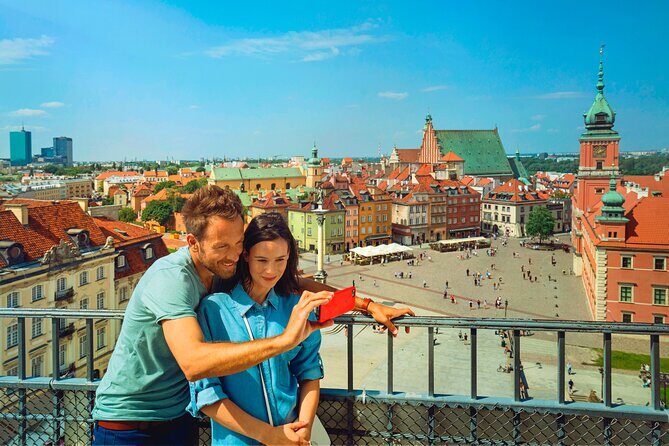
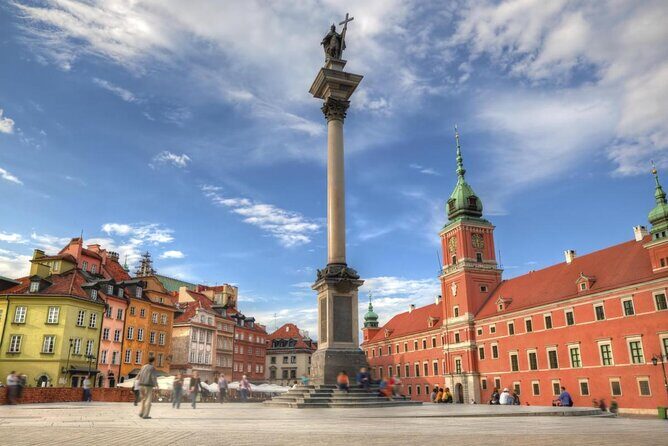
You begin at Sigismund’s Column on plac Zamkowy, and that’s a smart first move. The column is described as Warsaw’s oldest public memorial, but it wasn’t stuck in place. It was moved when the street axis changed in the 19th century and moved again after WWII during development of the WZ route.
That detail is more than trivia. It’s your first lesson in how Warsaw’s physical layout has been edited by time—street plans change, governments redraw priorities, and monuments follow the new order. You also learn the darker WWII moment: on September 2, 1944, German troops brought the column down, and reconstruction was completed in 1949.
If you’re the type who likes to know what you’re looking at before you look further, this opening makes you more confident right away.
UNESCO Old Town: seeing the trade route city, then the 1944 loss
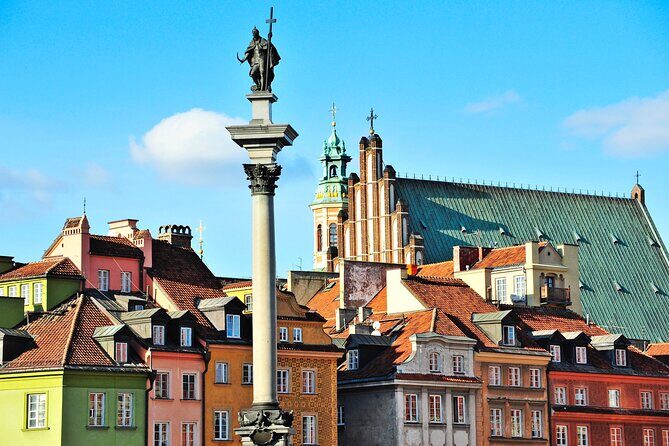
Next comes the Old Town, the neighborhood that grew quickly because it sat on a trade-friendly river route between the Baltic Sea and the Black Sea. The tour framing here helps you picture why merchants and craftsmen built up the area, and why early Warsaw looked very different over centuries.
You’ll hear how wooden structures were replaced by masonry after fires, and how earth ramparts became stone walls. Then the tour hits the turning point: in 1944, about 90 percent of the Old Town area was razed.
What I like about this stop is that it doesn’t just say destroyed and rebuilt. It connects the before/after with the current UNESCO recognition—this is reconstruction with a purpose, not an abstract memorial. The time you spend here feels like an explanation of why the Old Town looks the way it does today.
Possible drawback: the story is heavy. If you’re hoping for a purely scenic walk, you’ll still get the drama of occupation, destruction, and rebuilding baked into the walk.
Royal Castle Gardens: where royal power and wartime retaliation meet
From the Old Town you shift to Warsaw Royal Castle Gardens. This is a brief stop, but it carries a lot of meaning because the Royal Castle’s life mirrors Warsaw’s brutal history.
The castle became a royal residence in the 16th century when Masovia joined the Crown. Then it was destroyed multiple times—during events like the Deluge and later conflicts—and repeatedly rebuilt. By WWII, it was bombed early and then nearly destroyed by fire. Some works of art were evacuated in time, but what remained was plundered, and in 1944 the castle was blown up in retaliation for the Warsaw Uprising.
The rebuilding decision came much later, with work started after 1971 and the site opening to visitors in 1984. Like the Old Town, it later received UNESCO listing as an example of a faithful reconstruction of a historic structure.
This stop is good for readers who like cause and effect. You’ll walk away knowing the castle isn’t simply “pretty Warsaw.” It’s a case study in why rebuilding can be political, cultural, and emotional all at once.
St. John’s Archcathedral: old walls, national moments, and organ music
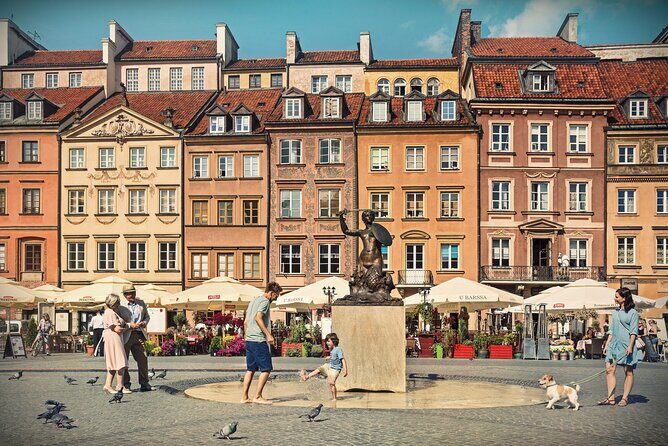
At the Archcathedral Basilica of St. John the Baptist, the tour moves from citywide damage and rebuilding to national identity in one building. St. John’s is among Warsaw’s oldest churches, and it has layers: historic events, a crypt with tombs, and a connection to major Polish milestones.
One specific highlight you’ll hear is the Constitution of May 3 oath, noted as the first of its kind in Europe. The church also ties into living tradition: every Sunday at 4 PM from July to September, concerts are held here as part of the International Organ Music Festival.
If you happen to be in Warsaw during that season, this information is useful. Even if you’re not attending the concert, knowing the schedule helps you time your visit to get more than just exterior photos.
A quick note: this stop is short, so if you want longer inside time, you may need a separate visit outside the tour’s pace.
Other private tours in Warsaw


Rynek Starego Miasta and the Warsaw Mermaid: a square with layers
Then you hit Rynek Starego Miasta, the Old Town Marketplace. This is where Warsaw’s history turns into everyday life. The square is surrounded by tenement buildings, many of which now house restaurants, cafes, clubs, and galleries.
The tour also points out a symbol you’ll likely see repeated around the city: the Warsaw Mermaid, added as a statue to the central marketplace area. The square is also broken into sections honoring enlightenment activists—named as Kołłątaj, Dekert, Barss, and Zakrzewski.
What makes this stop more than a postcard spot is the way it ties together people and ideology. You see where the city gathered, then you learn the names Warsaw chose to remember.
Practical tip: this is a good moment to get a snack break or a quick drink because you’re back in the heart of places where locals actually stop.
Barbican Warszawski: defenses you can walk, and an exhibition if the season fits
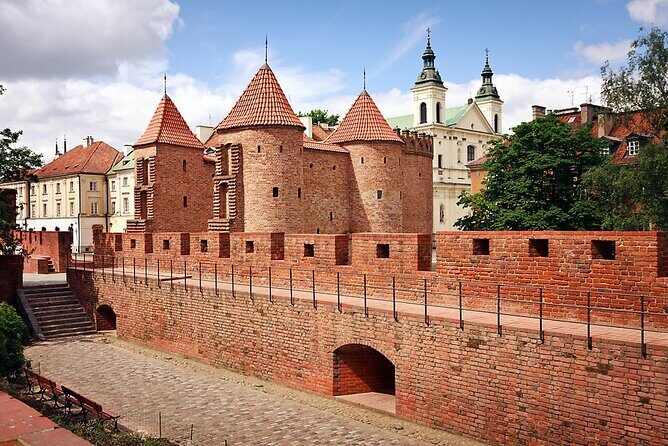
Warsaw’s defenses are usually talked about in general terms, but the Barbakan makes it tangible. Built in 1548, it was a strategic part of the city defensive walls and sits along the defensive line that once extended roughly 4,000 feet.
The tour notes what’s happening today too—artists and musicians often use the area, which changes the mood from strictly military to human-scale city life.
From May to October, there’s an exhibition inside the Barbican that includes historic photos and scale models of defense lines and towers that no longer exist. If you’re there in that window, this is one of the spots where the guided explanation can pay off extra because you can compare what you’re seeing now to what stood here before.
If you’re visiting outside those months, you can still use the guide’s photos-and-plans talk to mentally reconstruct the old shape of the Old Town.
Warsaw Uprising Monument and the quiet power of remembrance
Next is the Warsaw Uprising Monument, showing insurgents during battle. The tour framing makes the stakes clear: the Uprising ended in defeat, and around 200,000 Poles died. That number is delivered for a reason—this isn’t a lightweight “war statue,” it’s one of the city’s core reminders of what was paid and what was lost.
Right near it, you also get the connection to nearby buildings like Krasiński Palace (Palace of the Republic), originally tied to Jan Krasiński, Prefect of Warsaw, and now used for special collections connected to the National Library. The park behind the palace is also described as a relaxation spot that was once among the first public places available regardless of social status.
This area gives you a useful reset. After walking through the dense Old Town core, you get space to absorb the meaning without constant forward motion.
Consideration: if emotional monuments feel intense for you, plan to keep your pace slower at this point. Don’t rush the meaning.
Ulica Miodowa: one narrow street, several stories at once
Ulica Miodowa is a narrow lane packed with old residences and a surprisingly varied cast of buildings. This is where the tour shifts from “big national events” to “who lived here and what institutions they built.”
You’ll get specific stops along the street:
- No. 24 used to host the Collegium Nobilium, described as the first school for the young of the ruling elite. Today it houses the Academy of Theatre.
- No. 17 is the residence of the Primate of Poland, called the Palace of Warsaw’s Archbishops, built in the 18th century.
- No. 16 is Warsaw’s only Eastern Catholic Church.
- You’ll also hear about the Pac Palace, housing the Ministry of Health.
The guide also points out the Church of the Capuchins, including the heart of Jan III Sobieski kept on the altar’s right side (linked to the church’s founder). And if you walk far enough along, there’s a view of the Monument of Warsaw’s Heroes, nicknamed the Monument of Nike.
This stop is ideal if you like architecture and institutional history. It’s also a good “slow walk” segment where street details matter.
Plac Teatralny and the Grand Theatre: civic culture, postwar rebuild, and façades
At Plac Teatralny (Theatre Square), you’re in a different mood: culture, performance, and big public buildings. The square is bordered by Late Baroque features, including the Blank Palace and the Jabłonowski Palace area.
The tour shares a useful rebuilding angle here: Jabłonowski Palace had function as a city hall before WWII, was razed, and then rebuilt in the 1990s—yet only the façade and clock tower remain from the original design. The guide encourages you to walk through the gate under the tower to see the foundations laid in the 19th century.
Then comes the Grand Theatre, a huge Classicist building facing Jabłonowski Palace. It houses the National Opera and National Theatre, and the stage is described as one of the largest in Europe. Even if you don’t attend a performance, the interiors are referenced as impressive, with cut-glass chandeliers and a spacious foyer.
Near the end of this square is the Petrykus Tenement House (erected in 1821), now filled with restaurants and clubs valued by Warsaw citizens.
Tomb of the Unknown Soldier: the noon guard moment
The Tomb of the Unknown Soldier is one of those places where the details matter: an eternal flame, an honor guard, and urns from Polish battlefields.
The tour explains that the symbolic tomb commemorates millions of soldiers who fought for Poland’s freedom. It also states what’s buried here: ashes of a defender of Lvov and an urn with soil from World War I battlefields. Today, the tomb holds urns from every battlefield where Polish troops fell in the last century, and an eternal flame is kept burning.
The honor guard watches over it, with a change daily at noon.
Even if you’re not there at noon, knowing the guard changes at that specific time helps you plan your pace. It also makes the site feel alive rather than just symbolic.
Ending on the Royal Route: from Zamkowy Square to Trzech Krzyży Square
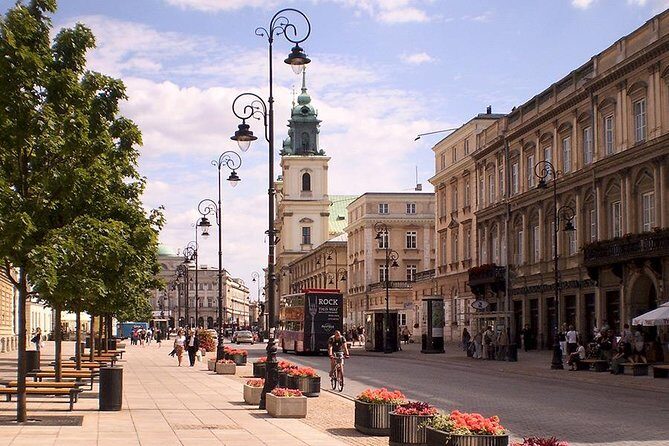
The tour’s final stretch is the Royal Route, said to run from Zamkowy Square to Trzech Krzyży Square. You’re shown the general spine of the route, plus examples of must-sees.
Among the highlights named:
- St. Anne’s Church with a view from the tower
- Polonia House, formerly the Museum of Industry and Trade, connected to Maria Skłodowska-Curie’s work
- Radziwiłł Palace, the current residence of the President of Poland
- Warsaw University campus with Kazimierzowski Palace
- Czapski Palace, home to the Academy of Fine Arts
- elegant shopping and dining along Nowy Świat Street, described as an extension of Krakowskie Przedmieście Street
A practical note that affects how you should plan your day: the guide’s walking tour ends around the area near Krakowskie Przedmieście, after leaving you near the Nicolas Copernicus Monument. That means you should treat the end point as a launch pad for your own exploring rather than the end of sightseeing.
Price and value: what $111.75 gets you in four hours
At $111.75 per person for roughly 4 hours, the price can make sense because the itinerary covers a lot of “core Warsaw” with free admission noted at each stop. That’s not just convenient; it helps keep your day from turning into a long list of extra ticket costs.
You’re also paying for something hard to fake on your own: the guided explanations that connect monuments to street changes, rebuild decisions, and national turning points. And because it’s private, you’re not stuck listening to a group that wants different things than you do.
One more value signal: the route is English-language guided with a professional local guide, and it uses a mobile ticket so you don’t waste energy on paperwork.
Who should book this private Warsaw Old Town tour?
This fits best if you:
- want a history-forward walk with strong context, especially around WWII and reconstruction
- like compact routes that hit the biggest symbols without turning into a full-day marathon
- prefer a private pace where you can ask questions and get straight answers in English
- value getting local food and sightseeing suggestions from a guide (past groups specifically note recommendations for snacks)
If you’re the kind of traveler who wants long museum interiors and lots of free wandering time, you might find the four hours feel tightly scheduled. In that case, use the tour as your orientation day, then return later for longer independent time.
Should you book this Warsaw Old Town private tour?
Yes, if you want to understand Warsaw instead of just walking through it. The route is packed, but it’s packed with meaning: monuments you’ll see everywhere, the UNESCO Old Town with its rebuilt logic, and key sites tied to national memory.
Book it if you like clear guidance and you want the tour to help you connect dots—especially around how the city has been reshaped after destruction. Skip it only if you want a light, purely scenic day with minimal historical intensity.
FAQ
Is this tour private or group-based?
It’s listed as a private tour/activity, meaning only your group participates.
What language is the tour guide?
The tour is offered in English.
How long is the Private 4h Tour in Warsaw Old Town?
The duration is approximately 4 hours.
How much does the tour cost?
The price is $111.75 per person.
Where do we meet and where does the tour end?
You start at Sigismund’s Column, plac Zamkowy, 00-001 Warszawa, Poland. The tour ends on the Royal Route, Krakowskie Przedmieście, 00-079 Warszawa, Poland, with the guide leaving you near the Nicolas Copernicus Monument.
Are there admission tickets required for the stops?
The itinerary lists admission ticket free for the stops included.
Do I need a paper ticket?
No. The tour uses a mobile ticket.
Can I cancel for free?
Yes. Free cancellation is available up to 24 hours in advance for a full refund.