REVIEW · WARSAW
Jewish Legacy in Warsaw. Private Tour with the best local specialist.
Book on Viator →Operated by Trips and Travels Poland · Bookable on Viator
Warsaw remembers in plain stone and street names. What makes this experience stand out is the way it strings key places together into a clear story of survival, confinement, and resistance without losing your footing. I love that you start at a still-standing synagogue and end up at ghetto-era decision points you can actually locate in today’s city. I also like the time focused on POLIN Museum, because it helps you understand what you’re seeing instead of just checking boxes. One drawback to keep in mind: a morning no-show has been reported once, so you’ll want to pay close attention to pickup instructions and be ready to contact the guide if things go sideways.
This is a private tour up to 3 people, starting at 9:00 am, with pickup arranged around Warsaw. If you like a guided walk that stays organized (and doesn’t turn into a free-for-all), this format fits well. It’s also built for accessibility in the sense that it’s not listed as extreme, and service animals are allowed.
In This Review
- Key highlights you’ll care about
- What this Jewish legacy route covers, and why it feels different
- Nożyk Synagogue: the oldest surviving thread in the city
- POLIN Museum: a 50-minute orientation you’ll appreciate later
- Fragment of the ghetto wall: seeing the border still in the map
- Umschlagplatz: the cargo railroad terminal story is heavy, but clear
- Mila 18 memorial: the uprising’s hiding place
- Monument time: Heroes of Warsaw and Willy Brandt’s gesture
- Chłodna Street bridge and the ghetto’s dangerous edge
- Praga-North streets and The Pianist locations near the Villa
- Price and what you’re really paying for (private, up to 3)
- Getting the timing right: 9:00 am start and pickup coordination
- Should you book this private Jewish legacy tour?
- FAQ
- What time does the tour start?
- Is pickup offered?
- What group size is this tour for?
- What language is the tour offered in?
- Is there a mobile ticket?
- Which sites are included on the route?
- How long do the main stops last?
- Is it accessible for most travelers?
Key highlights you’ll care about
- Small group of up to 3 means you can ask questions without waiting your turn
- A tightly themed route linking Nożyk Synagogue, ghetto wall remnants, Umschlagplatz, and major memorials
- 50 minutes at POLIN Museum to orient yourself before moving deeper into ghetto history
- Multiple “you are here” moments at sites tied to deportations and the uprising
- Chłodna Street and Praga-North add street-level context and connect to The Pianist filming locations
- One operational risk: pickup timing can matter on a 9:00 am start
What this Jewish legacy route covers, and why it feels different
This tour is built around a chain of real locations tied to Warsaw’s Jewish history: religious life that persisted, the creation of the ghetto system, and the places where deportations and armed resistance played out. The trick is that you’re not rushing through ten separate sites with generic commentary. The route uses short, specific time blocks at each stop so you can look, listen, and connect the next location in your mind.
You’ll spend the bulk of your time at the most meaningful stops: the Nożyk Synagogue (20 minutes), POLIN Museum (50 minutes), then several ghetto-critical points including the Fragment of Ghetto Wall, Umschlagplatz, and the Memorial at Mila 18. After that, you finish with monuments and a walk through the ghetto’s physical edges, plus Praga-North street scenes connected to The Pianist.
Even if you know the headlines, this route helps you understand how Warsaw’s geography became part of the story. That’s the big value for you: you’re learning where things happened, not just what happened.
Other private tours in Warsaw
Nożyk Synagogue: the oldest surviving thread in the city
You start at Nożyk Synagogue (Twarda 6), described as the oldest existing synagogue in Warsaw. The key point you’ll hear is why it survived: the Nazis did not destroy it because of its location and usefulness in the final phase of the ghetto period. That detail matters because it shows you how even sacred spaces could be bent into the logic of the occupiers.
In 20 minutes, you should expect a focused visit rather than a long ceremony-like experience. This first stop works as a baseline. It gives you a sense of what life and worship looked like before the city’s Jewish communities were sealed into the ghetto system. It also prepares you emotionally for what comes next, because the story shifts quickly—from continuity to destruction.
Practical note for you: since this is an early stop at a major site, it’s a good moment to get any orientation questions out of the way before you move into museum-and-memorial mode.
POLIN Museum: a 50-minute orientation you’ll appreciate later
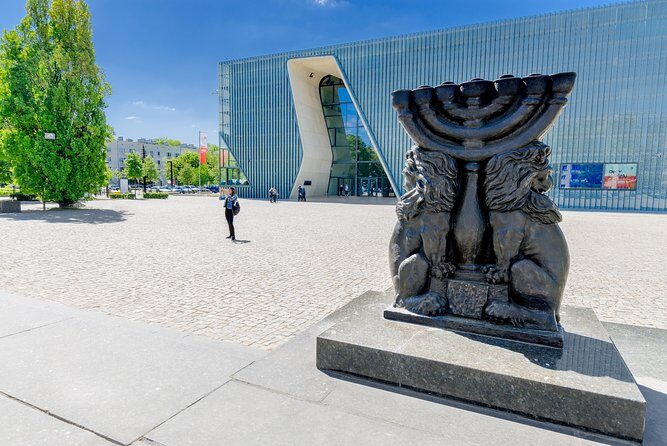
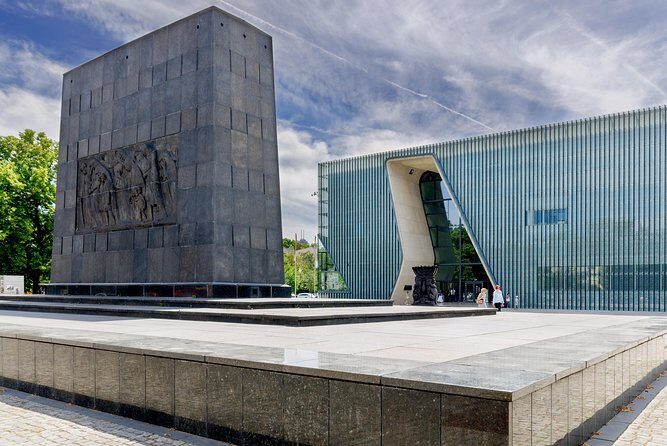
Next is POLIN Muzeum Historii Żydow Polskich (Mordechaja Anielewicza 6). You get 50 minutes here, including a quick look inside the museum and time spent at the location itself. POLIN is repeatedly singled out as an important place for Jewish legacy in Poland—one of the first to present the subject in a wide, proper perspective.
That “proper perspective” is exactly what you want when you’re about to visit places tied to deportations and resistance. Without context, locations like Umschlagplatz and Mila 18 can feel like isolated memorial plaques. With POLIN in the background, they start to click into a timeline.
Keep your expectations realistic: 50 minutes is not a full museum day. But it’s long enough to get oriented—enough time for the guide to connect what you’ll see with what the museum explains, and for you to absorb a few key themes instead of scanning everything.
Fragment of the ghetto wall: seeing the border still in the map
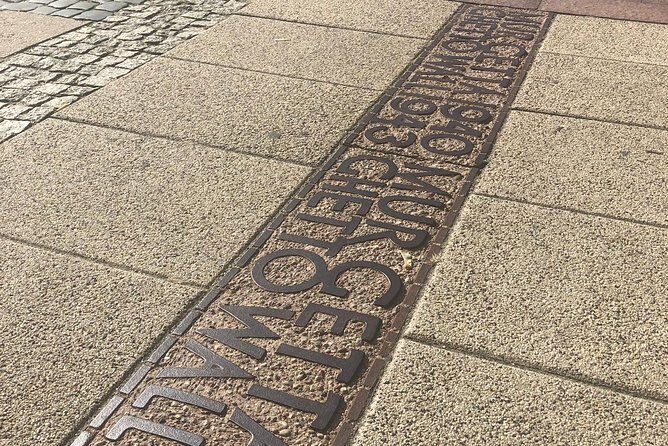
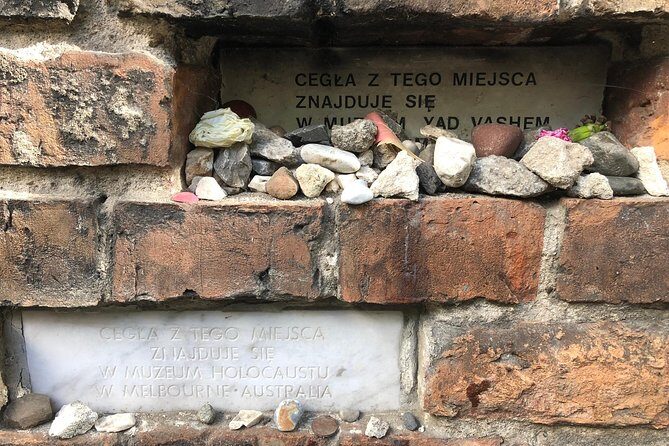
After the museum, the tour moves to the Fragment of Ghetto Wall (Zlota 60). This is described as the only remaining fragment of the largest Jewish ghetto that was ever existing, and it’s officially recognized by Chaim Herzog in 1992. You’ll spend 20 minutes here.
What you’re gaining is a physical sense of boundary. A lot of Holocaust-era history is talked about in terms of policies and dates. A remaining wall segment turns that into something you can stand near and point to—literally. You can visualize the squeeze: where people were forced to live, and where movement was restricted.
This stop is also a reminder that history isn’t only in documents or exhibits. It’s in the city fabric. Even in today’s Warsaw, you can locate the lines that shaped people’s lives.
Umschlagplatz: the cargo railroad terminal story is heavy, but clear
Then comes Umschlagplatz at the corner of Stawki and Dzika. The tour calls it the cargo railroad terminal in the ghetto. This is one of the most sobering locations on the route because it’s tied directly to deportation: it’s described as the place where Jews were taken to Treblinka Death Camp.
You get 20 minutes at this stop, which again suggests a focused, guided experience rather than a long contemplation marathon. Still, even a short visit can land hard, especially because the site is presented as a place of logistics—rail, transit, and the machinery that turned human beings into shipments.
If you’re trying to understand how a place becomes a system, this stop does it. You’re not learning a generic tragedy; you’re seeing the point in space where the process accelerated.
Other POLIN and Jewish heritage tours in Warsaw

Mila 18 memorial: the uprising’s hiding place
Next is the Memorial at Mila 18 (corner of Mila and Dubois). The tour highlights it as the largest bunker in the Jewish ghetto in Warsaw. You’ll spend 20 minutes here, with emphasis on the leadership and resistance that hid there—specifically Mordechaj Anielewicz, plus nearly 30 other members of the Jewish fighting organization.
This is the point in the route where the story shifts from being carried to being chosen. Resistance isn’t presented as a vague idea; it’s attached to a physical space—one bunker, one set of rooms, one place where decisions were made under impossible pressure.
For you, the value of this stop is the mental contrast it creates. After seeing deportation logistics at Umschlagplatz, Mila 18 gives you the other side of the same era: the drive to fight back, even when outcomes were grim.
Monument time: Heroes of Warsaw and Willy Brandt’s gesture
The tour passes Willy Brandt Square and the monument to Willy Brandt, where he’s described as kneeling in front of the monument of the ghetto heroes as a symbol of apology and reconciliation. This is a quick pass-by moment, but it changes the emotional tone: from wartime history to modern acts of remembrance.
Then you visit the Monument to the Heroes of Warsaw at Nowy Przejazd, with 50 minutes allocated here. The tour notes that this monument is devoted to the memory of the Jews who went through the nightmare of the ghetto.
This portion of the route matters because remembrance isn’t only about the past. It’s about what a city decides to mark and how it chooses to speak to visitors. With this stop lasting 50 minutes, you should get more than a glance—you’ll likely have time to let the guide explain the framing behind the monument and why these stories are still being taught.
Chłodna Street bridge and the ghetto’s dangerous edge
After that, you move to Chłodna Street (Chłodna), where the tour points out a footbridge linking a smaller ghetto section with the larger ghetto area. You get 10 minutes at this stop, which is short, but that’s exactly how a place like this should be treated: it’s a quick “this is the connection” moment.
The guide’s emphasis here is that this was described as the liveliest part of the ghetto and also the most dangerous. That’s a powerful detail for you because it challenges the idea that the ghetto was only uniform suffering. People still moved, gathered, and lived in ways that were shaped—and distorted—by the same brutal system.
In ten minutes, you won’t memorize every street corner. But you’ll leave with a better sense of how the ghetto’s internal geography worked.
Praga-North streets and The Pianist locations near the Villa
The final content block is Praga Polnoc (Zabkowska). This is where you get street-level context connected to film history: the tour describes this area as a selection of streets where Roman Polański produced shots for The Pianist. You’ll spend 40 minutes here.
This stop is also where the route offers an optional detour: a visit to the villa from the book The Zoo Keeper’s Wife. The tour notes that the villa visit depends on guest interest, so you’ll be able to adjust based on how much you care about the literary or film side of Warsaw’s modern cultural memory.
What I like about ending here is that you shift from strictly ghetto-era sites into the neighborhoods where visitors now walk every day. The connection to The Pianist can be a helpful bridge if you already know the story through film, but you’ll still be grounded in place.
Price and what you’re really paying for (private, up to 3)
The price is $361.23 per group, for up to 3 people. That can feel high until you do the math. If you’re traveling as the full three-person group, you’re closer to about $120 per person—which starts to look reasonable for a private English guide spending most of the morning moving between major sites.
You’re also paying for more than talking. You’re buying:
- A private format so the pacing stays on you
- Pickup offered around Warsaw, meaning you’re not spending time figuring out transit between distant stops
- Mobile tickets, so you’re not juggling paper confirmations
- English-speaking specialist guidance, which matters for sites that can be confusing without context
One more value point: this route is scheduled to avoid the all-day trap. It concentrates time at the most important stops—like the 50 minutes at POLIN and the 50 minutes at the Heroes monument—then uses shorter windows (10–20 minutes) for precise location moments like the ghetto wall fragment and Umschlagplatz.
Getting the timing right: 9:00 am start and pickup coordination
This experience starts at 9:00 am, with pickup for guests from around Warsaw. That’s convenient, but morning pickups can be the make-or-break part of any private tour. One documented issue involved a guide not showing at the expected pickup time, which led to a refund. I can’t guarantee your morning will be perfect, but you should treat pickup timing as real logistics—not a vague suggestion.
For your own peace of mind:
- Make sure your phone is charged in the morning
- Keep an eye on the time and pickup details sent close to departure
- If you’re the kind of person who hates waiting, show up a little earlier than the email suggests
Also note that the tour is described as having near public transportation, so even if you do not use pickup, you can likely arrange an easy meeting location on your own. Still, you’ll get the smoother experience if you rely on the pickup plan as intended.
Should you book this private Jewish legacy tour?
Yes, if you want a structured Warsaw route that links the biggest Jewish legacy sites into one coherent story. This is a strong fit for you if you:
- Like walking between specific places tied to real events
- Want English guidance rather than piecing together your own narrative
- Travel with up to two companions (because the per-person value improves)
You might hesitate if you’re very sensitive to timing and morning coordination. The one no-show incident is a reminder that private tours are still dependent on people showing up on time.
If you’re hoping for a long, museum-day experience with hours inside every exhibit, this route isn’t built that way. But if you want a powerful, place-based overview—starting at Nożyk Synagogue, moving through POLIN, and finishing with the ghetto’s edges and Praga film streets—this is a solid choice.
FAQ
What time does the tour start?
The tour start time is 9:00 am.
Is pickup offered?
Yes. Pickup is offered, and the tour picks up guests from all around Warsaw.
What group size is this tour for?
It’s a private tour/activity, and your group will be the only group participating. The price is per group up to 3.
What language is the tour offered in?
The tour is offered in English.
Is there a mobile ticket?
Yes, a mobile ticket is offered.
Which sites are included on the route?
Stops include Nożyk Synagogue, POLIN Museum, a fragment of the ghetto wall, Umschlagplatz, the Memorial at Mila 18, the Monument to the Heroes of Warsaw, Chłodna Street, and Praga-North.
How long do the main stops last?
Durations listed include: Nożyk Synagogue 20 minutes; POLIN Museum 50 minutes; ghetto wall fragment 20 minutes; Umschlagplatz 20 minutes; Memorial at Mila 18 20 minutes; Monument to the Heroes of Warsaw 50 minutes; Chłodna Street 10 minutes; Praga-North 40 minutes.
Is it accessible for most travelers?
The tour indicates most travelers can participate, and service animals are allowed. It is also described as near public transportation.